
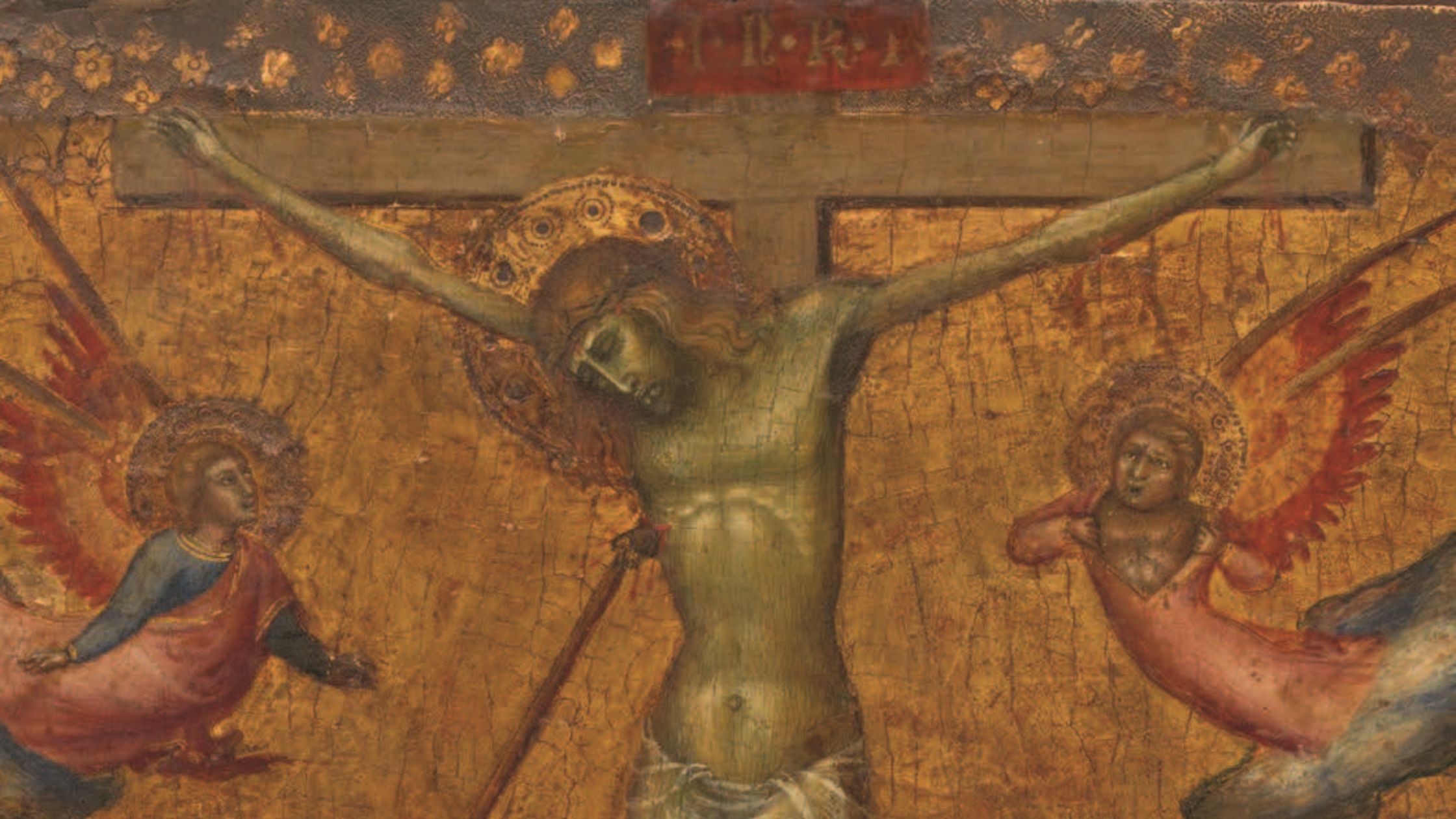
One of my favourite images for Jesus is an arrow: the strong, swift arrow that takes our humanity straight to the Father’s heart. It’s a great image for Lent: the fact that Ash Wednesday sometimes gets caught up with all the Valentine images of red hearts and golden arrows makes us think of it more readily. God, in Christ, is always reaching out to be reconciled with us. And Christ, our brother, is always taking our good intentions to the heart of the Father. But the real reason to think of Jesus the Arrow, now, and all through Lent, is because the image helps with our understanding of sin. From the start, this season confronts us with a strong sense of iniquity: our own sins and the sins of all the world. In truth and with the psalmist, we say throughout this season: ‘My offences, truly, I know them; my sin is always before me’ (Ps 50). It’s not just our sins that are before us. This is not just a moment of truth but a moment of decision too. At the beginning of Lent, we also hear: ‘See, today, I set before you life and prosperity, death and disaster – choose life then!’ (Deut 30:15).
How many times have we faced the moment of truth about ourselves and the moment of decision to change? And how many times have we accepted neither?! Having over half a century of Lents under my belt makes me shudder – and if I didn’t think often of the Arrow, it’d either make me feel completely frustrated or make me want to hang my head in shame. But, you see, the Scriptures describe sin as “missing the mark” – as all those things we’ve done and not done that fall short or go astray, like arrows that miss. Things that don’t reach their goal or fail to come to completion: all that is inadequate, frustrated, incomplete in our life and in our world: this is sin according to the Scriptures. Yet, this is not how we were in the beginning. This is not how God made us. We were on target then – humanity was heading to heaven. So, there’s something terribly sad about sin – that it has frustrated who we are and spoiled the good work of God in us. It has frustrated us; made us a people who can no longer reach the goal for which we were made.
Yet, Jesus, the Son of God, has reached the heart of the Father in His and in our humanity. Straight as an arrow He went. Tempted, but unswerving, He took our nature with Him and through His death and Resurrection, set us free. The temptations of Christ that we always recall on the First Sunday of Lent, represent all that throws us off course. At the beginning of the Forty Days, we join Jesus in the desert: the place of truth and decision. In our weakness we feel very much united to Him. But we want to be united to His strength too.
The Gospels tell us that the Spirit drove Jesus into the desert and that the angels ministered to Him there. The powerful wind of God’s Spirit carried the straight arrow of His intention, and under the inspirations of those good spirits, the angels, these intentions came to fulfilment, to fruition. What a grace, then, to consider the angel that carries the spear or arrow at this time: the spear that the soldier thrust into Christ’s side and up into His Sacred Heart, opening up a way for humanity to receive the fruits of His Passion and death. In our church of Our Lady of Grace, St John stands by the Cross and looks up. He points to the side of Christ, to the place where the arrow entered, as if to invite us to that place. We know from St John’s Gospel, don’t we, that this is the role of the Beloved Disciple? In the Cenacle, at the Supper, he lay close to Jesus’s breast, close to that place where all beloved disciples are invited. This is why, in the Prologue of his Gospel, that Beloved Disciple speaks of Jesus being “closest” to the Father’s heart. Through His death and Resurrection, Jesus has taken up that place eternally. He has taken up that place in our flesh. Through prayer and contemplation, John invites us to his place at the Supper and at the foot of the Cross. This is so that Christ’s place, closest to the Father’s heart, might be ours. Prayer is the instrument by which we will take up this place: Christ’s prayer, that goes to the heart of God like a swift, straight arrow.
Through contemplation and prayer, the Carmelite tradition of St Teresa of Jesus and St John of the Cross has always sought to make this place on Calvary its own. They have much to teach the whole Church about how to arrive here and make this place our own. Maybe we could contemplate for a few moments the reality of the Arrow in the life of Teresa of Avila? Perhaps you’ve seen the wonderfully evocative statue of Teresa of Avila by Gian Lorenzo Bernini in the Church of Santa Maria della Vittoria in Rome. It says more about her prayer life than any written representation might. St Teresa is depicted, reclining backwards and looking upward, wrapped in an experience of God in prayer. A small angel stands over her and holds an arrow, as though about to pierce her heart. Around the two figures is a shower of golden light. In her autobiography, Teresa says this about the moment Bernini sought to capture:
It was Our Lord’s will that in this vision I should see the angel in this wise. He was not large, but small of stature, and most beautiful – his face burning, as if he were one of the highest angels, who seem to be all of fire: they must be those whom we call cherubim. Their names they never tell me; but I see very well that there is in heaven so great a difference between one angel and another and between these and the others that I cannot explain.
I saw, in his hand, a long spear of gold and at the iron’s point there seemed to be a little fire. He appeared to me to be thrusting it at times into my heart and to pierce my very entrails; when he drew it out, he seemed to draw them out also, and to leave me all on fire with a great love of God. The pain was so great, that it made me moan; and yet so surpassing was the sweetness of the excessive pain, that I could not wish to be rid of it. The soul is satisfied now with nothing less than God. The pain is not bodily, but spiritual; though the body has its share in it, even a large one. It is a caressing of love so sweet which now takes place between the soul and God, that I pray God of His goodness to make him experience it who may think that I am lying.
In her lifetime, through prayer, Teresa reached the heights of sanctity. She was able to receive the love of God in an extraordinary way. To her dying day, she maintained that experiences cannot be our motivation in prayer and that they are not essential to the communication between God and the soul. What is necessary, is the recognition that the initiative in prayer is God’s. By God’s grace we are given the arrow that can lead us to Him. It is an arrow which touches us with something of His fire. God communicates the fire of His love to our hearts and moves them to turn to Him. In prayer, God gives us an instrument of His Passion; the arrow that pierced Christ’s side and opened up the spiritual life of the Church. Through, in, and with Christ, Our Lord, we make our prayer to the Father. The Catechism of the Catholic Church puts it this way:
Contemplative prayer is silence, the “symbol of the world to come” or “silent love”. Words in this kind of prayer are bot speeches; they are like kindling that feeds the fire of love. In this silence, unbearable to the “outer” man, the Father speaks to us his incarnate Word, who suffered, died and rose; in this silence the Spirit of adoption enables us to share in the prayer of Jesus. (CCC 2717)
The fiery arrow which God has given us in Christ, we return to the Father in faith, through the Holy Spirit. This is why the Catechism also teaches:
Prayer is both a gift of grace and a determined response on our part. It always presupposes effort. The great figures of prayer of the Old Covenant before Christ, as well as the Mother of God, the saints, and He himself, all teach us this: prayer is a battle. Against whom? Against ourselves and against the wiles of the tempter who does all he can to turn humanity away from prayer, away from union with God. (CCC 2725)
Likewise, it’s a tactic of the enemy to discourage us and make us think our prayer is weak and unsuccessful. If the prayer is made in Christ, the Arrow, there is no room for such discouragement, because the Arrow takes us straight to the Beloved’s heart. Hence, on Tuesday of Holy Week there’s a wonderful first reading at Mass from the Prophet Isaiah which, considering the image of the arrow, encourages us in our prayer.
He made my mouth a sharp sword
and hid me in the shadow of his hand.
He made me into a sharpened arrow,
and concealed me in his quiver.
He said to me, ‘You are my servant (Israel)
in whom I shall be glorified’;
while I was thinking, ‘I have toiled in vain,
I have exhausted myself for nothing’;
and all the while my cause was with the Lord,
my reward with my God.
I was honoured in the eyes of the Lord,
my God was my strength.
And now the Lord has spoken,
he who formed me in the womb to be his servant,
to bring Jacob back to him,
to gather Israel to him.
(Isa 49:2-5, Jerusalem Bible)
Find strength in Jesus during Lent with our book Arma Christi
 This blog is an extract from Arma Christi: Lenten Reflections on the Instruments of the Passion. In this short self-guided Lenten retreat, Fr Philip Caldwell offers meditations on the “Arma Christi” – implements of Christ’s Passion – and considers the great mystery in which the tools used to wound Our Lord became His weapons in conquering sin and death and winning for us Salvation.